

Small Dog. Wild Ancestry.
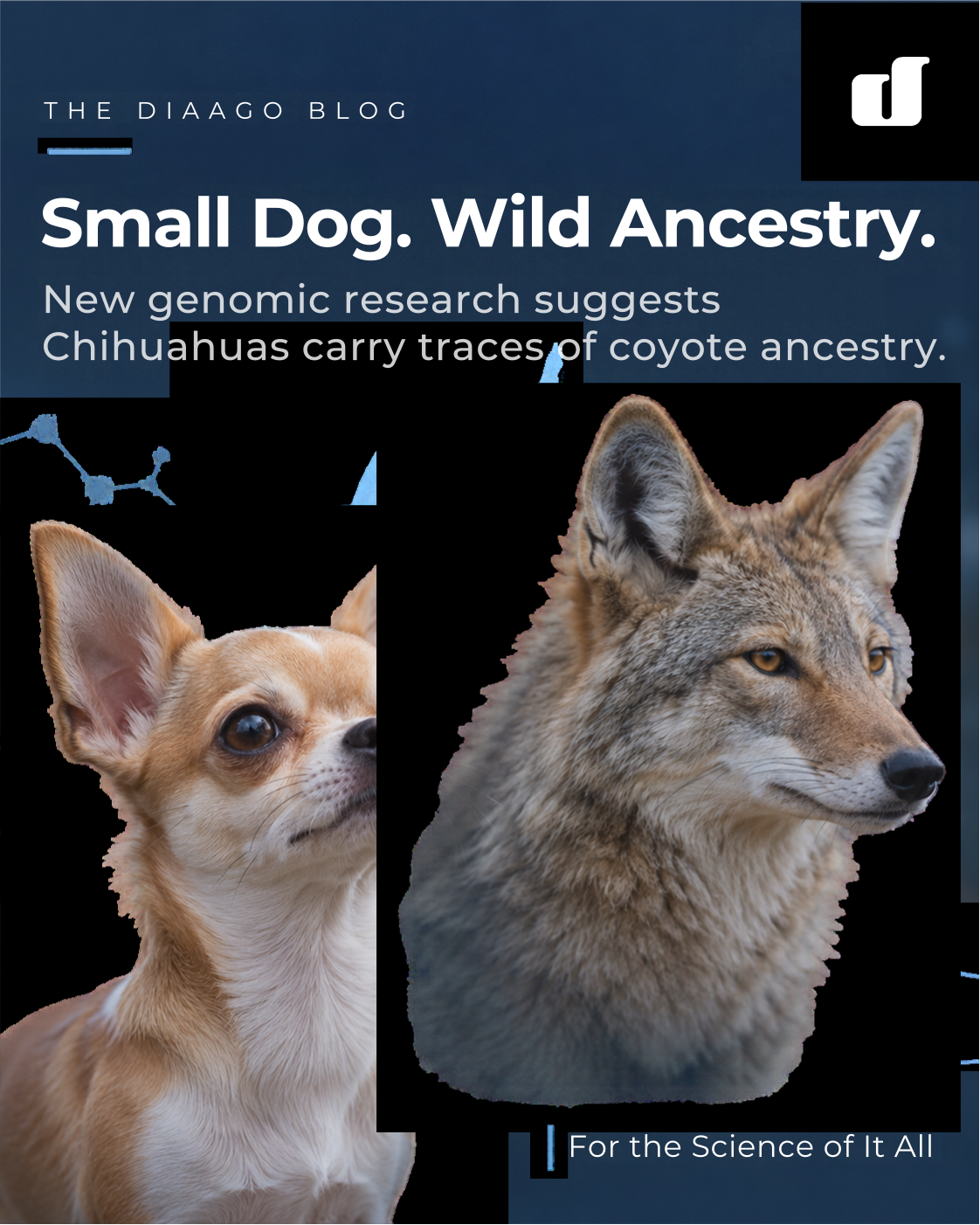
If you've ever met a Chihuahua that acts like it could take on an animal five times its size, this discovery might make you laugh.
Turns out, these tiny dogs have a surprisingly wild family history.
Researchers at Stanford University have identified traces of coyote ancestry in Chihuahua DNA, uncovering an unexpected connection between one of the world's smallest dog breeds and its much larger wild relatives.
And no, this doesn't mean your neighbor's Chihuahua is secretly a coyote. But the science behind it is pretty fascinating.
A Little Coyote in the Family Tree
In a study published in Nature Communications, researchers used advanced genetic analysis tools called Gnomix and Gnofix to investigate the ancestry of different animals.
The technology allows scientists to examine individual sections of DNA and trace where they may have originated.
While studying canine genomes, the team discovered that a Chihuahua carried DNA segments linked to wild coyotes.
The exact timing of this genetic mixing remains unknown, but evidence suggests the connection may date back to before Europeans arrived in the Americas.
So, while your average Chihuahua probably spends more time demanding attention than roaming the wilderness, its genetic family tree tells a much more adventurous story.
And Chihuahuas Aren't the Only Ones
The researchers also found something interesting about another Mexican dog breed: the Xoloitzcuintli, or Xolo for short.
These distinctive, often hairless dogs were found to carry genetic ancestry associated with ancient Arctic dogs, making up roughly 4% of their genome.
Both discoveries offer a glimpse into the history of dogs in the Americas and the genetic connections that have survived across generations.
As for whether that tiny bit of coyote ancestry explains a Chihuahua's famously oversized confidence? The researchers haven't established that connection.
But we wouldn't blame anyone for wondering.
Small Dogs, Big Discoveries
Beyond the amusing thought of a Chihuahua sharing ancestry with a coyote, there's some impressive science behind this finding.
Modern genomics allows researchers to uncover genetic relationships that would have been nearly impossible to identify just a few decades ago.
By combining DNA data with powerful computational tools, scientists can piece together evolutionary histories, identify ancient ancestry, and better understand how species have changed over time.
And sometimes, those discoveries come from the last place you'd expect.
Like a five-pound dog barking at absolutely nothing.